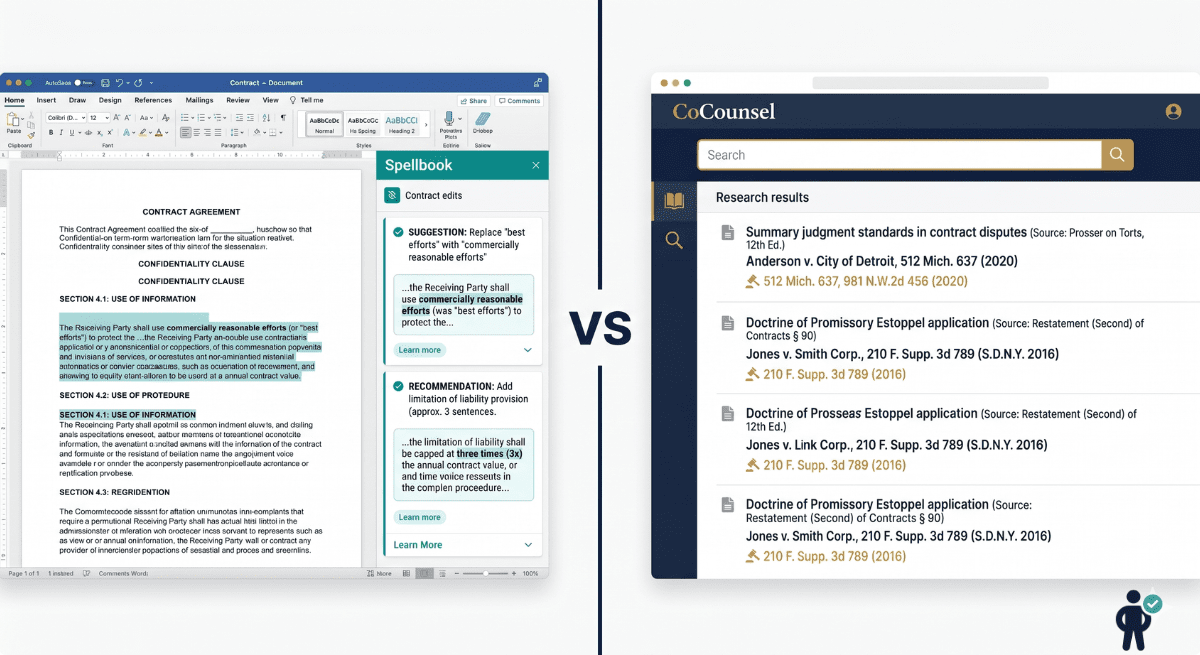
Spellbook vs CoCounsel: The 30-Second Verdict
- Spellbook wins for transactional and contract-heavy practices — Word-native, market data grounded, faster ROI
- CoCounsel wins for litigation and research-heavy practices — Westlaw depth, Practical Law integration, broader legal scope
- Spellbook pricing starts at $89/user/month; CoCounsel starts at $90+ plus Westlaw subscription costs
- Spellbook’s 2026 Associate agent handles multi-document workflows autonomously — biggest new feature this year
- CoCounsel’s 2026 agentic beta enables multi-step research chains — still in beta, not fully released
- For 80% of law firms: Spellbook delivers better daily ROI; for research-intensive litigation firms: CoCounsel is worth the premium
The “Different Lanes” Reality: Why This Isn’t a Head-to-Head Comparison
Think of it this way: asking “Should I buy Spellbook or CoCounsel?” is like asking “Should I buy a drafting table or a law library?” The answer depends entirely on whether you spend your days writing contracts or researching case law. For the 60%+ of law firms whose revenue comes primarily from transactional and advisory work, Spellbook is the clear productivity multiplier. For litigation boutiques and regulatory compliance shops, CoCounsel’s Westlaw integration is irreplaceable. For full-service firms — you likely need both, deployed to different practice groups.
This guide evaluates each tool within its proper lane, then provides a clear decision framework based on your practice profile — not generic feature checkboxes.
Introduction: Spellbook vs CoCounsel – Two Legal AI Approaches
The legal AI market in 2026 has largely bifurcated into two distinct philosophies — and Spellbook and CoCounsel are the clearest representatives of each. Understanding which philosophy fits your practice is the only question that matters when choosing between them.
Spellbook was built from the ground up as a contract intelligence platform, operating natively inside Microsoft Word with no context switching required. Its defining differentiator is access to a proprietary database of thousands of executed commercial contracts, which allows it to benchmark clause language against real market standards in real time — not just generate plausible text. In 2026, Spellbook released its Associate AI agent, which can autonomously handle multi-document tasks like drafting entire agreement sets, running comparative redlines across clause versions, and flagging missing provisions against playbooks — without the lawyer manually prompting each step.
CoCounsel, developed by Thomson Reuters, takes a fundamentally different approach: it is a research and analysis platform powered by the depth of the Westlaw and Practical Law ecosystems. Where Spellbook excels at contract drafting speed, CoCounsel excels at legal research accuracy, case law synthesis, and standards checking against Practical Law’s curated playbooks. Its 2026 beta update introduces agentic workflows that can chain multiple research and analysis tasks together — though this remains in limited beta release as of this writing.
Both tools are legitimately good. The mistake most law firms make is evaluating them against each other on features rather than evaluating each against their own practice workflow. This guide does both.
Core Features Comparison Table (2026)
| Feature Category | Spellbook 2026 | CoCounsel 2026 | Winner |
|---|---|---|---|
| Contract Drafting | ✅ Word-native, AI clause generation, market benchmarking | ⚠️ Portal-based, template dependent | Spellbook |
| Contract Review / Redline | ✅ In-Word redlines, risk flagging, market comparison | ⚠️ Document analysis portal — not Word-native | Spellbook |
| Legal Research | ❌ Not designed for case law research | ✅ Westlaw-powered, case synthesis, jurisdiction filtering | CoCounsel |
| Playbook / Standards Checking | ✅ Market data grounded, custom playbook support | ✅ Practical Law integration, firm-specific playbooks | Tie |
| AI Agent / Autonomous Tasks | ✅ Associate agent (GA) — multi-doc autonomous workflows | ⚠️ Agentic beta — limited availability | Spellbook |
| Microsoft Word Integration | ✅ 100% Word-native — no context switching | ⚠️ Word add-in available but secondary to web portal | Spellbook |
| Market / Precedent Data | ✅ Thousands of executed contracts, real-time benchmarks | ❌ Static Westlaw content — no live contract market data | Spellbook |
| Case Law & Statute Research | ❌ Not a research tool | ✅ Full Westlaw access, citation verification | CoCounsel |
| Security (SOC2 Type II) | ✅ SOC2 Type II + HIPAA | ✅ SOC2 Type II (Thomson Reuters standards) | Tie (Spellbook HIPAA edge) |
| Starting Price | $89/user/month | ~$90+/user/month + Westlaw | Spellbook |
Spellbook Deep Dive: Contract AI Built for Commercial Law
Spellbook’s fundamental design decision — to live entirely inside Microsoft Word — turns out to be one of its most strategically sound choices. Lawyers already live in Word. Their clients send Word documents. Negotiations happen in tracked-changes Word files. By eliminating the need to copy-paste between a browser portal and Word, Spellbook removes the friction point that kills adoption of most legal AI tools.
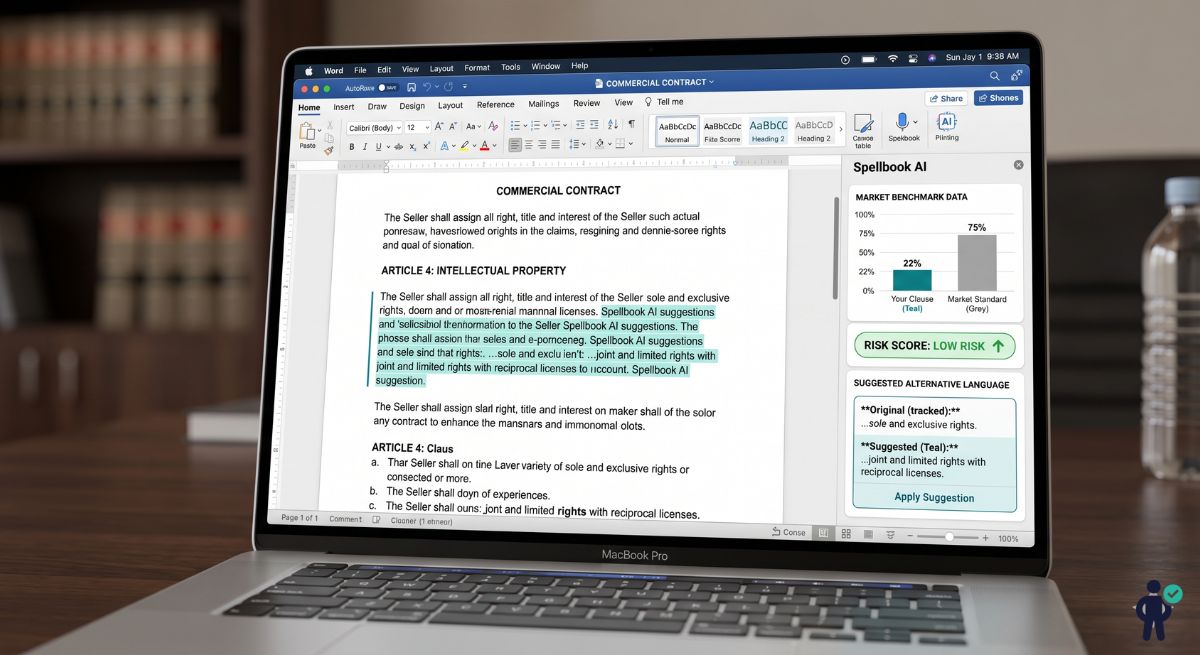
The practical workflow looks like this: a lawyer opens a contract in Word, activates Spellbook from the ribbon, and begins reviewing. Spellbook surfaces risk flags, alternative language suggestions, and market benchmark comparisons in a sidebar panel that updates as the cursor moves through the document. There is no separate interface to learn, no upload/download cycle, and no version management problem. The document stays as the single source of truth throughout.
Beyond the workflow advantage, Spellbook’s Associate AI agent — released to general availability in early 2026 — represents a meaningful leap in legal AI capability. Associate can be assigned multi-step tasks like: “Review this NDA against our standard playbook, flag deviations, suggest alternative language for each deviation, and produce a summary memo.” This chain of tasks runs autonomously, returning results the lawyer can review and accept, reject, or modify. Early adopters report reducing first-pass contract review time by 60–80% on routine commercial agreements.
Spellbook’s Unique Market Data Grounding
This is the feature that genuinely differentiates Spellbook from every other legal AI tool on the market in 2026, including CoCounsel. When Spellbook suggests clause language or flags a provision as unusual, it grounds that assessment in a database of thousands of actual executed commercial contracts — not generated text or static legal reference materials.
What this means in practice: when reviewing a limitation of liability clause, Spellbook can tell you that the cap proposed by the counterparty is at the 12th percentile of market deals — meaning 88% of similar agreements have a higher cap. This is negotiation intelligence, not just drafting assistance. It shifts the lawyer’s position from “I think this is below market” to “data shows this is below market at the 12th percentile.”
For corporate lawyers negotiating commercial agreements daily, this market grounding is arguably worth the subscription cost on its own. It converts anecdotal experience into data-backed negotiating positions and provides defensible rationale to clients for why certain positions are worth fighting for.
CoCounsel Analysis: Thomson Reuters Research Powerhouse
CoCounsel’s strength derives entirely from its parent company’s most valuable assets: Westlaw and Practical Law. For any lawyer whose work centers on legal research — case analysis, regulatory interpretation, litigation strategy, statutory comparison — this integration represents a genuinely compelling value proposition that no other legal AI can match.
The core CoCounsel workflow operates through a web portal where lawyers submit research queries in natural language. CoCounsel synthesizes results from Westlaw’s database, surfaces relevant cases with citations, identifies conflicting authorities, and can generate research memos summarizing findings. The quality of research outputs is meaningfully better than general-purpose AI tools like ChatGPT or even Spellbook because every assertion is grounded in verified Westlaw content with proper citations — dramatically reducing the hallucination risk that plagues ungrounded legal AI.
CoCounsel also integrates Practical Law’s playbooks, which provide standardized clause-by-clause guidance on commercial agreements. For firms that already subscribe to Practical Law, this integration allows automated checking of contracts against Practical Law standards — a meaningful compliance and quality-control tool for associates doing routine document work.
The principal limitation is workflow fragmentation. CoCounsel’s primary interface is a web portal, and while a Word add-in exists, it is considerably less capable than the main platform. Lawyers using CoCounsel for document analysis must upload files to the portal, work with the AI there, and then return to Word to implement changes — a cycle that adds friction and, more critically, creates a version management risk on actively negotiated documents.
CoCounsel 2026 Beta: Agentic Workflows
Thomson Reuters announced CoCounsel’s agentic workflow capability in late 2025, with a limited beta running through 2026. The vision is compelling: multi-step research and analysis chains that can autonomously move from question to sub-questions to synthesis without manual re-prompting at each step. In demonstrations, CoCounsel’s agent can handle tasks like: “Analyze this contract for GDPR compliance issues, research relevant EU case law on each issue you identify, and draft a compliance memo with recommended revisions.”
The honest assessment at time of writing: the agentic beta shows real promise but is not yet at production quality. Output consistency and hallucination rates at multi-step chain length are still being refined. Firms interested in this capability should monitor Thomson Reuters’ 2026 release schedule rather than selecting CoCounsel today primarily on the basis of agentic features.
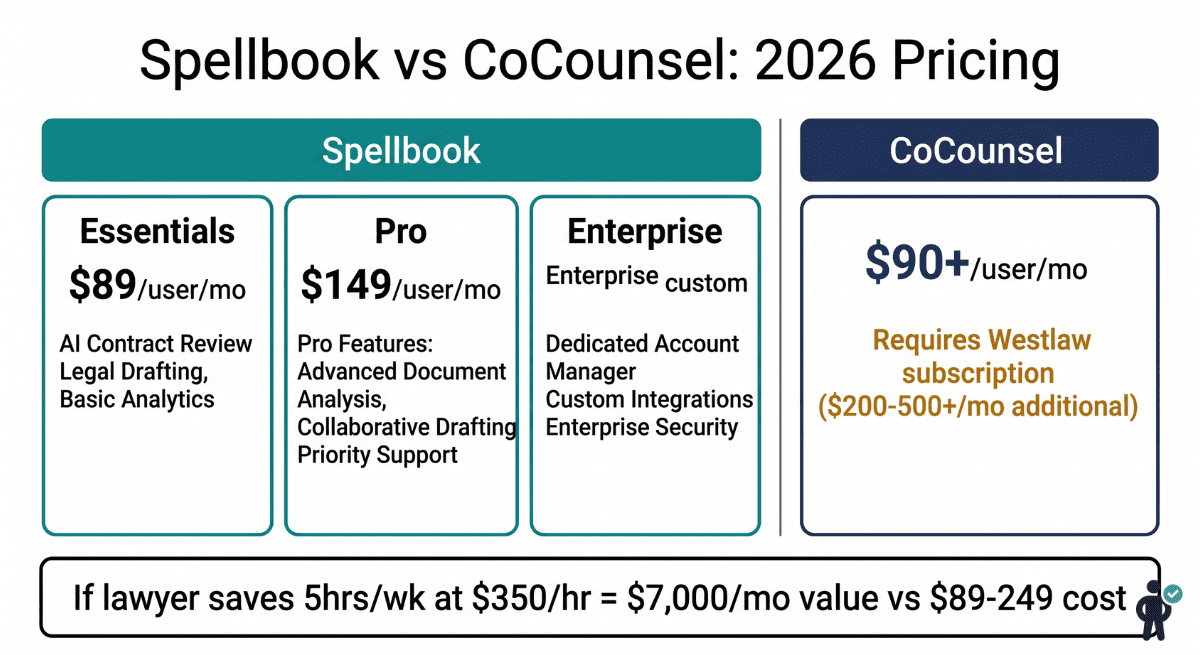
Pricing Comparison 2026 (Per User/Month)
| Plan | Spellbook | CoCounsel | Notes |
|---|---|---|---|
| Entry/Essentials | $89/user/month | ~$90/user/month | Spellbook includes market data at entry; CoCounsel needs Westlaw add-on |
| Professional | $149/user/month | Custom (includes Westlaw) | Spellbook Pro adds Associate agent; CoCounsel bundles TR ecosystem |
| Enterprise | Custom (volume discount) | Custom (full TR suite) | Both offer SSO, admin controls, priority support at enterprise tier |
| Westlaw Required? | No | Yes — adds $200–500+/user/month | Critical cost difference for firms without existing Westlaw subscriptions |
| Total Cost Estimate (5 users) | $445–$745/month | $1,450–$2,950+/month | Assumes CoCounsel + mid-tier Westlaw for 5 users |
The 2026 Casetext Pricing Backlash: What Solo and Small Firms Need to Know
Following Thomson Reuters’ acquisition of Casetext in 2023, the company progressively migrated legacy Casetext users to the CoCounsel Core product line throughout 2024–2025. By 2026, the pricing backlash from solo practitioners and small law firms has become a significant market factor that any honest comparison must address.
What happened: Legacy Casetext users who were paying $65–$110/month for AI-powered legal research found themselves facing 2x to 3x price increases upon forced migration to CoCounsel Core — with published pricing now scaling to $500+/month per attorney for full-feature access including Westlaw integration. The jump was not gradual; many firms reported receiving 60-day notices to migrate or lose access, with the new pricing representing a budget-breaking increase for practices billing under $500K/year.
The market response: This pricing migration has created a wave of solo and small-firm attorneys actively searching for alternatives. If CoCounsel’s total cost (tool + Westlaw) exceeds your practice’s budget, here are the leading alternatives by price tier:
| Tool | Monthly Price | Best For | Key Capability |
|---|---|---|---|
| Spellbook | $89–$149/user | Contract-heavy practices | Word-native drafting + market benchmarks (no Westlaw needed) |
| Gavel Exec | $145–$160/user | Document automation + client intake | Full practice workflow automation, intake-to-delivery pipeline |
| Paxton AI | $49–$99/user | Legal research on a budget | AI-powered research assistant at a fraction of CoCounsel’s cost |
| DocLegal.ai | $10/user | Basic document drafting | Template-based legal document generation, minimal AI research |
| CoCounsel Core | $90–$500+/user | Full Westlaw-powered research | Best-in-class legal research — but at BigLaw pricing |
ROI Calculation Framework: The way to evaluate either tool’s pricing is straightforward. If an associate billing at $250/hour saves 4 hours per week on contract review using Spellbook at $149/month, the monthly value generated is approximately $4,000 against a $149 cost — a 27:1 return on investment. Even at the conservative end, most transactional lawyers report recouping Spellbook’s cost in the first week of active use. CoCounsel’s ROI calculation is more favorable for research-heavy roles but requires the same discipline in measuring actual time savings.
Workflow Integration: Word-Native vs Web Portal (The Adoption Killer)
This is the practical day-to-day differentiator that features tables do not capture adequately — and it is the single biggest predictor of whether a legal AI tool gets adopted or abandoned within 90 days of purchase. Legal work is document work, and document work happens in Microsoft Word. The question of whether an AI tool integrates into that workflow or sits alongside it determines adoption rates more than any feature set.
Why Context-Switching Kills Legal AI Adoption
Transactional lawyers hate context-switching — and there is empirical data to support this. A 2025 study by the ABA’s Legal Technology Resource Center found that legal AI tools requiring a separate browser interface had 38% lower 90-day retention rates compared to tools operating within the lawyer’s existing document environment. The cognitive cost of alt-tabbing between Word and a portal, managing two versions of a document, and re-orienting after each switch adds up to 15–25 minutes of friction per hour of tool use.
Spellbook’s workflow (Word-native, zero context-switching): Open document → activate Spellbook from the ribbon → work. Every suggestion, redline, benchmark, and risk flag appears in context alongside the text it references. When the lawyer accepts a suggestion, it applies directly to the document as a tracked change. There is no copy-paste, no upload cycle, no separate window to manage. For lawyers doing 20+ contracts per week, this seamlessness compounds into significant time savings. The document remains the single source of truth from opening to final execution — no version management overhead.
CoCounsel’s workflow (portal-primary, hybrid friction): CoCounsel forces a split-attention model. The primary capabilities — research synthesis, document analysis, advanced compliance checking — live in a separate web portal. A Word add-in exists, but it is functionally a secondary interface that provides limited access to the full platform’s capabilities. In practice, this means:
- For document analysis: Upload contract to portal → wait for processing → review AI output in browser → switch back to Word to implement changes → manage two open windows simultaneously
- For research tasks: Open CoCounsel portal → submit query → review results → manually copy citations or analysis back into the Word document you’re drafting
- Version risk: If a counterparty sends a revised draft while the current version is uploaded to CoCounsel for analysis, the lawyer has a synchronization problem — the portal analysis references language that may no longer exist in the live document
Data Grounding & Accuracy: Market Standards vs Legal Research
The accuracy of a legal AI tool is only as good as the data it is grounded in — and Spellbook and CoCounsel are grounded in fundamentally different data sources designed for fundamentally different tasks.
Spellbook’s grounding: A proprietary database of thousands of executed commercial contracts, continuously updated. When Spellbook makes a suggestion or assessment, it can trace that recommendation to comparable executed deals. This grounding is uniquely valuable for transactional work because it reflects what parties actually agreed to — not what a treatise says they should agree to. The limitation is scope: this contract-market grounding does not extend to regulatory compliance, case law, or statutory interpretation.
CoCounsel’s grounding: Westlaw’s comprehensive legal database — case law, statutes, regulations, secondary sources, and Practical Law’s curated playbooks. For legal research accuracy, this is the gold standard. CoCounsel’s research outputs include proper Westlaw citations that can be verified, which dramatically reduces the hallucination risk that plagues generative AI in legal contexts. The limitation is that this grounding reflects what law says and what courts have decided — not necessarily what sophisticated commercial parties actually negotiate in practice.
The practical implication: for a lawyer asking “Is this indemnification clause unusual?” — Spellbook gives a better answer because it compares to actual market practice. For a lawyer asking “Does this indemnification clause expose us to liability under Delaware law?” — CoCounsel gives a better answer because it grounds in case law and statutory interpretation.
Security & Compliance (Enterprise Focus)
| Security Feature | Spellbook | CoCounsel |
|---|---|---|
| SOC 2 Type II Certified | ✅ Yes | ✅ Yes |
| HIPAA Compliance | ✅ Yes | ⚠️ Not explicitly certified |
| Data Retention Policy | Zero data training retention — client docs not used for model training | Thomson Reuters data policies — TR ecosystem retention rules apply |
| Data Residency | US/Canada options | TR infrastructure (primarily US) |
| SSO / SAML | ✅ Enterprise tier | ✅ Yes |
| Role-Based Access Controls | ✅ Yes | ✅ Yes |
| Audit Logs | ✅ Yes | ✅ Yes |
| Bar Association Compliance | ✅ Designed for ABA Model Rules compliance | ✅ Thomson Reuters legal compliance framework |
Both tools meet the baseline enterprise security requirements that law firms need. Spellbook’s HIPAA certification gives it an edge for firms that handle healthcare clients and need to process Protected Health Information in contract workflows. CoCounsel operates within Thomson Reuters’ established enterprise security infrastructure, which carries significant institutional trust for large firms already within the TR ecosystem.
The data retention policy distinction is worth noting: Spellbook explicitly commits that client documents processed through the tool are not used to train AI models — addressing a primary confidentiality concern that clients and bar associations have raised about legal AI tools. CoCounsel’s data policies should be reviewed carefully against a firm’s specific client confidentiality obligations before deployment.
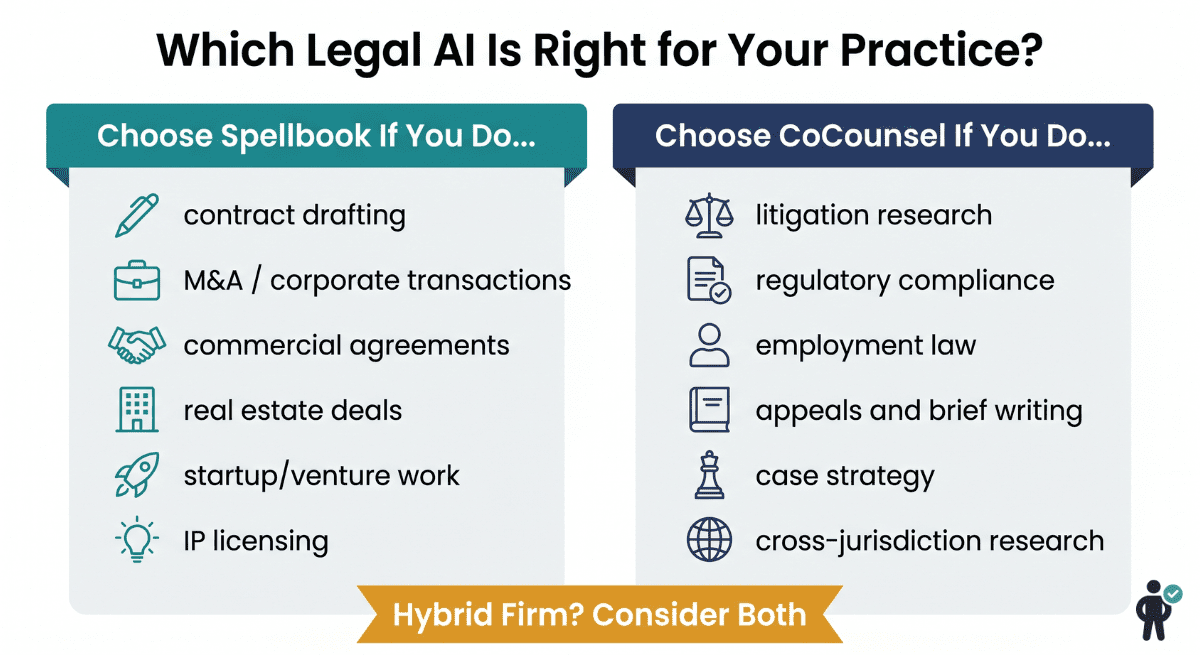
Use Case Breakdown: Who Wins For Your Practice?
| Practice Type | Recommended Tool | Primary Reason | Confidence |
|---|---|---|---|
| Corporate/M&A Transactional | Spellbook | Word-native drafting + market data benchmarks = direct deal workflow value | High |
| Commercial Contracts | Spellbook | Volume + speed of review; market grounding for negotiation positions | High |
| Litigation / Trial Prep | CoCounsel | Westlaw research depth; case synthesis; brief research acceleration | High |
| Regulatory Compliance | CoCounsel | Statutory and regulatory database access; jurisdiction-specific analysis | High |
| Employment Law | CoCounsel | Case law research + Practical Law employment playbooks | Medium-High |
| Real Estate | Spellbook | Contract drafting and review; lease clause benchmarking | Medium |
| IP / Licensing | Spellbook | Agreement drafting; market benchmarks for licensing terms | Medium |
| Startup / Venture | Spellbook | High-volume standard agreements; faster review cycles; cost efficiency | High |
| Full-Service / Hybrid Firm | Both | Different tools for different practice groups — budget permitting | Situational |
Pros & Cons Head-to-Head Table
Spellbook 2026:
✅ Spellbook Pros
- 100% Word-native — zero workflow disruption
- Unique live market data benchmarking
- Associate agent for autonomous multi-doc tasks
- Faster adoption curve for transactional lawyers
- HIPAA certified — healthcare client ready
- Lower total cost — no Westlaw dependency
- Strong adoption: Dropbox, Crocs, 4,000+ teams
- Zero training data retention policy
❌ Spellbook Cons
- Contract-focused — not a research tool
- Cannot replace Westlaw for litigation research
- Market data primarily US/Canada commercial contracts
- Less suited for regulatory/compliance deep dives
- Associate agent still maturing on complex tasks
CoCounsel 2026:
✅ CoCounsel Pros
- Westlaw integration = best-in-class legal research
- Practical Law playbooks for standards checking
- Verified citations — reduces hallucination risk
- Broad legal scope across all practice areas
- Thomson Reuters enterprise security infrastructure
- Ideal for litigation and research-intensive work
❌ CoCounsel Cons
- Requires Westlaw — adds $200–500+/user/month
- Primary interface is web portal — context switching
- Word add-in is secondary, less capable
- Agentic workflows still in beta — not production ready
- Higher total cost for smaller firms
- Thomson Reuters ecosystem lock-in
2026 Updates & Future Roadmap
Spellbook 2026 Updates: The Associate AI agent was the headline release — moving from beta to general availability in Q1 2026. Associate now handles multi-document comparison workflows, automated playbook checking across contract sets, and autonomous first-pass redlines on incoming counterparty documents. The roadmap signals expansion of Associate’s capabilities to include client-specific preference learning (where the agent learns a firm’s standard positions over time) and deeper integration with document management systems like iManage and NetDocuments.
CoCounsel 2026 Updates: The agentic workflow beta was announced at the Thomson Reuters Legal Technology Conference in late 2025 and is available to select enterprise customers in 2026. The beta enables multi-step research chains with minimal manual re-prompting. Thomson Reuters has also announced deeper Westlaw AI enhancements — including AI-powered “KeyCite Plus” that provides more nuanced treatment analysis beyond simple citation flags — integrated into CoCounsel’s research outputs. The roadmap points toward a more unified portal experience that reduces the disconnect between web-based research and Word-based drafting, though a true Word-native experience comparable to Spellbook’s is not on the publicly disclosed roadmap.
Customer Reviews & Case Studies (Real Lawyer Feedback)
Spellbook adoption signals: Spellbook has publicly cited adoption by more than 4,000 law firms and legal teams, with notable enterprise clients including Dropbox and Crocs. The G2 and Capterra review profiles show consistent praise for the Word integration and market benchmarking features, with the most common criticism being the limitation to contract work rather than broader legal research. Associates at mid-size corporate firms frequently report cutting first-pass NDA and services agreement review time from 45–90 minutes to under 15 minutes on routine documents.
CoCounsel adoption signals: CoCounsel’s adoption is strongest within the existing Thomson Reuters customer base — firms already on Westlaw Precision that add CoCounsel as an incremental capability rather than a standalone purchase. Large law firms with dedicated research departments report meaningful research time savings, particularly for complex multi-jurisdiction analysis that previously required significant associate hours to synthesize. The most consistent criticism in user reviews is the workflow fragmentation between the portal and Word environments.
Frequently Asked Questions (FAQ)
Q1: Is Spellbook or CoCounsel better for contract review?
Spellbook is significantly better for contract review in 2026. Its Word-native interface means review happens in the document itself without upload/download cycles. Its market data grounding means flagged issues are benchmarked against actual executed deals — not just general legal principles. And its Associate agent can run autonomous first-pass reviews on incoming counterparty documents, returning a structured redline and risk summary without manual prompting at each step. CoCounsel can review contracts through its portal, but the workflow is more fragmented and the market benchmarking capability does not exist. For contract-heavy practices, Spellbook delivers meaningfully better ROI on review workflows.
Q2: Does CoCounsel require a Westlaw subscription?
Yes — and this is the most important cost consideration that prospective CoCounsel buyers frequently underestimate. CoCounsel’s research capabilities are powered by Westlaw, and meaningful use of the platform’s differentiating features requires Westlaw access. For firms already paying for Westlaw Precision (the primary tier compatible with CoCounsel), adding CoCounsel is a relatively modest incremental cost. For firms without existing Westlaw subscriptions, the combined cost of Westlaw plus CoCounsel represents a significant investment — often $290–590+/user/month or more depending on firm size and Westlaw tier. Firms evaluating CoCounsel must model the total cost including Westlaw, not just the CoCounsel subscription price.
Q3: What is the pricing difference between Spellbook and CoCounsel in 2026?
Spellbook’s published pricing starts at $89/user/month for Essentials and $149/user/month for Pro (which includes the Associate agent). Enterprise is custom. CoCounsel starts at approximately $90/user/month but requires a Westlaw subscription that typically costs an additional $200–500+/user/month depending on the Westlaw tier selected. On a total cost-of-ownership basis for a 5-person team without existing Westlaw access, Spellbook costs approximately $445–745/month compared to $1,450–2,950+ for CoCounsel plus Westlaw. For firms with existing Westlaw subscriptions, the incremental cost of adding CoCounsel is closer to parity with Spellbook.
Q4: Which has better Microsoft Word integration — Spellbook or CoCounsel?
Spellbook — and it is not close. Spellbook was architected from the ground up as a Word add-in, and every feature is designed to operate natively within the document environment. CoCounsel’s Word add-in is a secondary interface grafted onto a primary web portal — it provides some functionality in Word, but the full platform capability requires using the browser portal. For lawyers spending their days in Word documents, this distinction has significant daily workflow implications. If Word integration is a priority criterion for your evaluation, Spellbook is the clear choice.
Q5: Can Spellbook replace Westlaw for legal research?
No — and Spellbook does not try to. Spellbook is a contract intelligence tool, not a legal research platform. It cannot search case law, synthesize judicial decisions, provide citation verification, or support the kind of statutory and regulatory research that Westlaw enables. If your practice requires regular access to case law and legal research — which includes virtually all litigation work and significant portions of regulatory, employment, and appellate work — Westlaw (and potentially CoCounsel’s AI layer on top of it) remains necessary. Spellbook and CoCounsel are genuinely complementary tools for firms that do both transactional and research-intensive work.
Final Verdict: Spellbook vs CoCounsel 2026 Winner
The honest verdict is that neither tool is universally better — they are purpose-built for different legal work. But if forced to name a winner for the broadest applicability across law firm types, Spellbook wins in 2026 for three reasons:
First, scope of impact. Approximately 80% of lawyer time in private practice involves drafting, reviewing, and negotiating documents. Spellbook directly accelerates this work in the environment where it already happens. CoCounsel’s research strength is genuinely powerful, but research represents a smaller proportion of most lawyers’ billable time than contract and document work.
Second, total cost of ownership. Spellbook’s ROI is faster and more predictable. For firms without existing Westlaw subscriptions, CoCounsel’s true cost is 3–4x Spellbook’s depending on firm size. For small and mid-size firms, this cost differential is difficult to justify without a research-intensive practice profile.
Third, workflow integration. Legal AI adoption fails when lawyers resist changing their workflow. Spellbook’s Word-native approach eliminates the primary resistance point — lawyers do not have to change how they work, just enhance it. CoCounsel’s portal-first approach requires behavioral change that can undermine adoption rates even when the tool’s outputs are excellent.
When CoCounsel wins: For litigation boutiques, appellate practices, regulatory compliance firms, and any practice where Westlaw research is a daily necessity, CoCounsel is the right choice — especially for firms already subscribed to Westlaw where the incremental cost is manageable. The depth of Westlaw-grounded research output has no peer in the legal AI market.