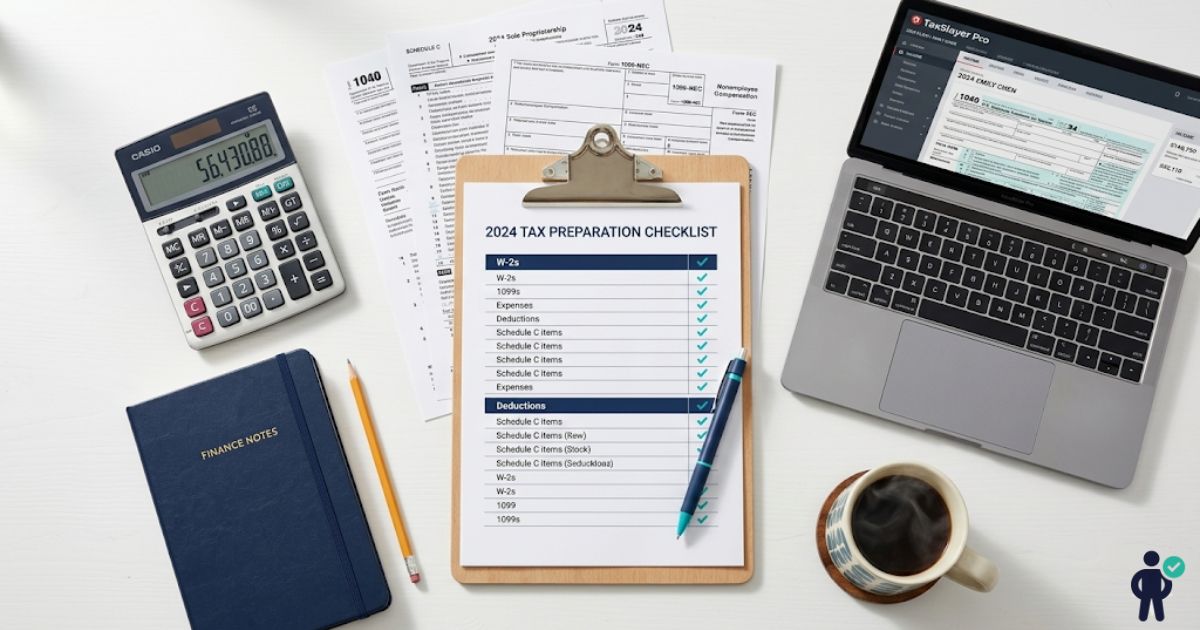
Introduction to Side-Hustle Taxes – Why This Checklist Matters
You started a side hustle to earn extra money — not to navigate a maze of IRS forms, self-employment taxes, and quarterly deadlines. But here is the reality most side-hustlers discover too late: every dollar you earn beyond $400 in net profit is taxable, and the IRS expects you to manage your own withholding, reporting, and payment schedule.
Unlike a traditional W-2 job where your employer handles taxes automatically, side-hustle income comes to you in full — with no withholding. That means the tax bill you were not expecting can hit hard in April if you have not been preparing. The general rule financial professionals recommend is straightforward: set aside 25–30% of every side-hustle payment in a separate account from the moment you receive it.
This checklist walks you through all 15 steps of the side-hustle tax process for the 2026 filing year — from tracking income and claiming deductions to calculating self-employment tax, making quarterly payments, and filing your return correctly. Whether you drive for Uber, sell on Etsy, freelance as a designer, or tutor students on weekends, this guide covers exactly what you need.
📋 The 15-Step Side-Hustle Tax Checklist (Overview)
- Step 1: Collect all 1099-NEC forms (due from payers by January 31)
- Step 2: Identify all income not covered by a 1099
- Step 3: Document cash, Venmo, Zelle, and barter income
- Step 4: Calculate total gross income from all sources
- Step 5: List all deductible business expenses
- Step 6: Complete Schedule C (Profit or Loss from Business)
- Step 7: Calculate self-employment tax using Schedule SE
- Step 8: Deduct half of SE tax on Form 1040
- Step 9: Check QBI deduction eligibility (up to 20%)
- Step 10: Calculate quarterly estimated tax payments
- Step 11: Verify all payment deadlines and amounts
- Step 12: Apply safe harbor rules to avoid underpayment penalties
- Step 13: Organize and store all receipts and records
- Step 14: Check state and local tax obligations
- Step 15: File Schedule C with Form 1040 by April 15
Steps 1–3: Track All Income Sources (What Counts as Taxable)
The first and most critical rule of side-hustle taxes: all income is taxable, regardless of whether you receive a 1099. Many first-time filers make the mistake of only reporting income that comes with an official tax form. The IRS requires you to report every dollar of self-employment income — documented or not.
Here is exactly what counts and what forms are involved:
1099-NEC (Non-Employee Compensation): Clients who pay you $600 or more during the calendar year are required to issue a 1099-NEC. This covers freelance work, consulting, tutoring, and any direct service income. You should receive this form by January 31, 2026, for income earned in 2025. Even if a client fails to send one, you are still legally obligated to report the income.
1099-K (Payment Card and Third-Party Network Transactions): This form comes from payment platforms like PayPal, Venmo Business, Etsy, eBay, Stripe, and Square. For the 2026 tax year, the reporting threshold remains at $20,000 and 200 transactions for most platforms — though this is an area of active IRS rule-making and is worth verifying before filing.
Cash, Zelle, and direct bank transfers: Income paid in cash or via personal bank transfers is taxable regardless of the absence of any documentation. Keep your own records of every payment received, including the date, amount, payer, and description of services.
Barter and in-kind income: If you exchange services (for example, a web designer who builds a site in exchange for accounting services), the fair market value of what you received is taxable income. This is frequently overlooked and represents a real audit risk.
Common Side Hustles Requiring 1099s
If you operate in any of the following areas, here is what income reporting looks like in practice:
| Side Hustle Type | Primary Income Form | Platform Issues 1099? | Notes |
|---|---|---|---|
| Uber / Lyft driving | 1099-K + 1099-NEC | Yes (Uber Tax Summary) | Mileage deduction critical |
| DoorDash / Instacart | 1099-NEC | Yes (if $600+) | Delivery mileage deductible |
| Etsy / eBay selling | 1099-K | Yes (platform issues) | COGS deductible for resellers |
| Fiverr / Upwork freelancing | 1099-NEC or 1099-K | Yes (if threshold met) | Software/tools deductible |
| Tutoring / coaching | 1099-NEC (from businesses) | Partial (individuals rarely do) | Self-report all cash income |
| Content creation / YouTube | 1099-NEC (AdSense) | Yes (Google issues) | Equipment + home office deductible |
| Handmade crafts (offline) | None (self-report) | No | All income self-reported |
Steps 4–6: Calculate Profit (Income − Expenses = Schedule C)
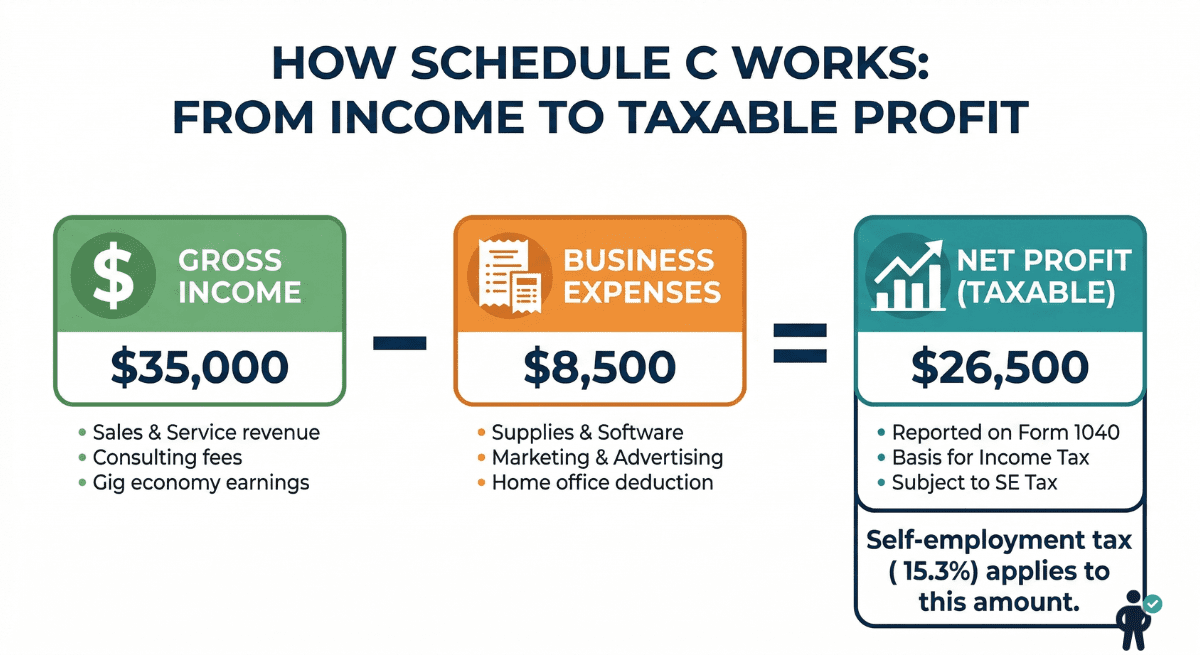
Once you have totaled all your income, the next step is calculating your net profit — which is the figure the IRS actually taxes. This is done using Schedule C (Form 1040): Profit or Loss from Business. Schedule C is a one-page form attached to your main tax return that reports your gross income, lists your deductible expenses, and arrives at your net profit (or loss).
The formula is straightforward: Gross Income − Business Expenses = Net Profit. You pay self-employment tax and income tax only on the net profit, which is why maximizing your legitimate deductions is so important — every dollar of documented expense directly reduces your tax bill.
Top 15 Side-Hustle Deductions Checklist
These are the most commonly missed and most valuable deductions available to side-hustlers filing Schedule C in 2026. Every item on this list requires documentation — keep receipts, invoices, and logs:
💰 Deductible Business Expenses — Complete List
- Business mileage: 70 cents per mile driven for business purposes in 2026 (IRS standard mileage rate — verify current rate before filing). Requires a contemporaneous mileage log.
- Home office deduction (Form 8829): The square footage of your dedicated workspace as a percentage of your total home. Space must be used regularly and exclusively for business.
- Internet and phone (business portion): The percentage of your monthly internet and phone bill used for business. Typically 50–80% for full-time side-hustlers.
- Software subscriptions: Any software used for your business — design tools, accounting software, project management, video editing, AI tools.
- Professional services: Accountant fees, legal fees related to your business, business coaching fees.
- Advertising and marketing: Social media ads, website hosting, domain fees, business cards, promotional materials.
- Office supplies: Paper, printer ink, pens, postage — any consumable supplies used for business.
- Equipment (Section 179 or depreciation): Cameras, computers, microphones, printers — deduct in the year of purchase using Section 179 or depreciate over time.
- Cost of goods sold (COGS): For product sellers — the cost of materials, wholesale inventory, and manufacturing costs.
- Bank and payment processing fees: PayPal fees, Stripe fees, business bank account fees.
- Education and training: Online courses, books, and subscriptions directly related to your business skills.
- Travel (business-specific): Airfare, hotels, and 50% of meals when traveling overnight for business purposes.
- Health insurance premiums: Self-employed individuals may deduct 100% of health insurance premiums for themselves and dependents (subject to income limits).
- Retirement contributions: Contributions to a SEP-IRA or Solo 401(k) are deductible and reduce taxable income significantly.
- Platform and marketplace fees: Etsy listing fees, Fiverr service charges, Upwork connects — all platform fees are deductible business expenses.
🚨 2026 Audit Hazard: Schedule 1-A Deductions & IRS Cross-Check Gaps
What this means for you: Just because a deduction doesn’t trigger an immediate rejection does not mean it’s safe. The IRS is allowing claims to pass through initial processing, then flagging returns with statistically unusual deduction-to-income ratios for manual review 12–18 months later. If you claim $15,000 in business expenses on $25,000 of side-hustle income, your return will be flagged — even if no automated system rejected it at filing time.
Our recommendation: Be more conservative with deductions in 2026, not less. Document everything with contemporaneous records (receipts at time of purchase, not reconstructed). If a deduction feels borderline, consult a CPA before claiming it. The penalty for fraud (75% of underpayment) versus negligence (20%) makes aggressive filing strategy extremely risky in this enforcement environment.
Legit vs. Non-Legit Write-Offs: What You Can (and Cannot) Deduct
One of the fastest ways to trigger an audit is claiming personal expenses as business deductions. The IRS draws a hard line between expenses that are “ordinary and necessary” for your business and personal expenses that happen to make you look or feel more professional. Here is the definitive comparison:
| Expense | Deductible? | IRS Rationale |
|---|---|---|
| Business meals with clients (active discussion of business) | ✓ Yes (50%) | Ordinary and necessary; directly tied to income generation. Must document who, where, what was discussed. |
| Home office (dedicated, exclusive space) | ✓ Yes (100%) | Regular and exclusive business use. Calculated via simplified ($5/sq ft) or actual-expense method. |
| Business mileage (client visits, supply runs) | ✓ Yes (70¢/mi) | Ordinary business travel. Requires contemporaneous mileage log with date, destination, purpose. |
| Software subscriptions (used for business) | ✓ Yes (100%) | Direct business tool. Adobe, Canva, QuickBooks, project management — fully deductible. |
| Professional development (courses, conferences) | ✓ Yes (100%) | Maintains or improves skills required in your current business. Must relate to existing business. |
| Equipment (laptop, camera, microphone) | ✓ Yes (Section 179) | Business asset. Deduct full cost in year of purchase via Section 179 or depreciate over useful life. |
| Botox / cosmetic procedures (before keynote, photoshoot) | ✗ No | Personal expense. Not ordinary or necessary for any trade. No exceptions even for public-facing roles. |
| Manicures / haircuts / salon visits | ✗ No | Personal grooming. Cannot be deducted even if done exclusively before client meetings or video recordings. |
| Professional wardrobe (suits, business casual) | ✗ No | Clothing suitable for everyday wear is personal. Only costumes/uniforms unsuitable for daily use qualify. |
| Gym membership / fitness classes | ✗ No | Personal health expense. Not deductible even for fitness influencers or personal trainers (IRS position). |
| Commute to coworking space (regular office) | ✗ No | Commuting is personal. Only travel between business locations (not home to first stop) qualifies. |
| Meals eaten alone / personal lunches | ✗ No | Personal sustenance. Only meals with active business discussion with a client/prospect qualify (at 50%). |
Steps 7–9: Self-Employment Tax (15.3% on Net Earnings)
Self-employment tax is the most commonly underestimated tax obligation for side-hustlers. When you work for an employer, Social Security and Medicare taxes are split equally — you pay 7.65% and your employer pays 7.65%. As a self-employed individual, you pay both halves: a total of 15.3% of your net self-employment earnings.
This is calculated using Schedule SE (Self-Employment Tax) and is completely separate from your federal income tax. Both are owed on April 15.
Here is how the calculation works in practice:
| Income Level | Net SE Income | SE Tax (15.3%) | Federal Income Tax (est.) | Total Owed |
|---|---|---|---|---|
| Low earner | $5,000 | $765 | ~$550 (10% bracket) | ~$1,315 |
| Part-time hustler | $15,000 | $2,295 | ~$1,650 (12% bracket) | ~$3,945 |
| Active side-hustler | $30,000 | $4,590 | ~$3,300 (12% bracket) | ~$7,890 |
| Near full-time | $50,000 | $7,065 | ~$6,500 (22% bracket) | ~$13,565 |
Two important offsets to know about:
Deduction for half of SE tax: The IRS allows you to deduct 50% of your self-employment tax when calculating your adjusted gross income on Form 1040. This partially offsets the burden of paying both halves.
Qualified Business Income (QBI) deduction: Most sole proprietors and single-member LLCs can deduct up to 20% of their qualified business income from their taxable income under Section 199A. This deduction phases out at higher income levels and has specific rules — consult a tax professional if your net income exceeds $182,400 (single) for the 2025 tax year.
Steps 10–12: Quarterly Estimated Tax Payments (Avoid Penalties)
If you expect to owe at least $1,000 in federal taxes from your side-hustle income, the IRS requires you to make quarterly estimated tax payments throughout the year. These are not optional — failing to make them, or underpaying them, triggers an underpayment penalty that is calculated separately from any tax you owe at filing.
Use Form 1040-ES to calculate and submit your quarterly payments. You can pay online through the IRS Direct Pay system at irs.gov/payments — no paper check required.
2026 Quarterly Payment Calendar and Amounts Table
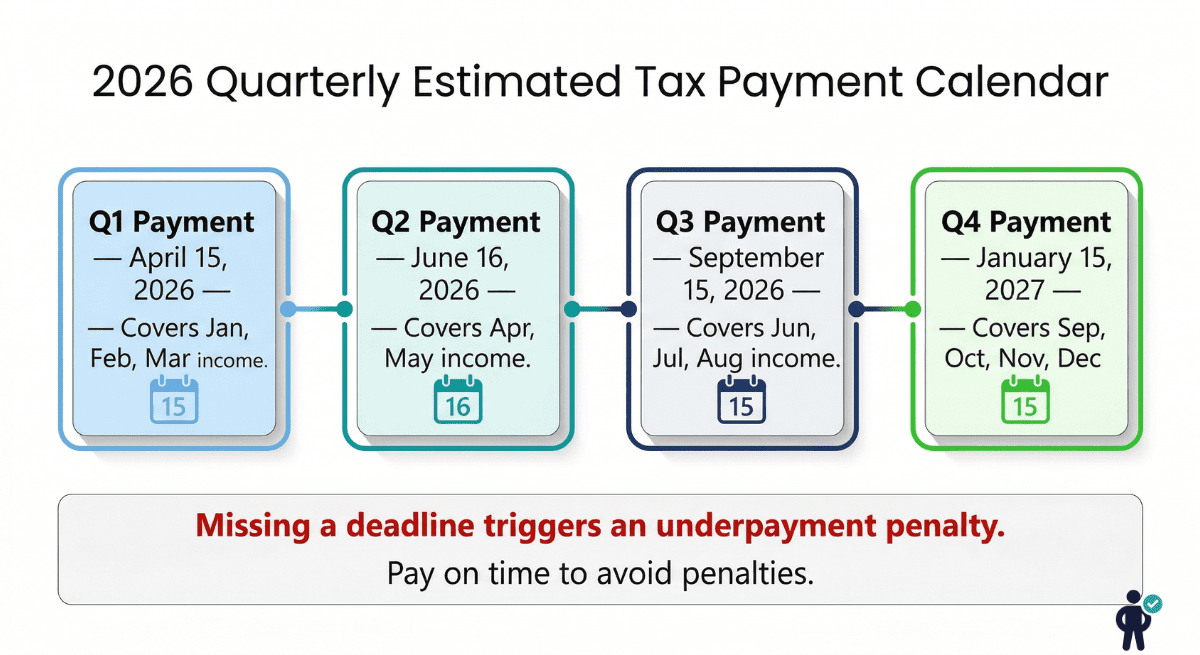
| Quarter | Income Covered | Payment Due | Est. Payment ($20K/yr earner) | Est. Payment ($50K/yr earner) |
|---|---|---|---|---|
| Q1 | January – March | April 15, 2026 | ~$985 | ~$3,390 |
| Q2 | April – May | June 16, 2026 | ~$985 | ~$3,390 |
| Q3 | June – August | September 15, 2026 | ~$985 | ~$3,390 |
| Q4 | September – December | January 15, 2027 | ~$985 | ~$3,390 |
The Safe Harbor Formula: Exactly How Much to Pay Each Quarter
The IRS safe harbor rule protects you from underpayment penalties regardless of how much you actually owe at filing — as long as your quarterly payments meet one of two thresholds. Here is the exact formula financial professionals use:
Where:
- T2026 = your estimated total tax liability for the current year (2026)
- T2025 = your actual total tax liability from last year (from your 2025 return)
- α = 1.00 if your 2025 AGI was $150,000 or less
- α = 1.10 if your 2025 AGI exceeded $150,000
Translation: Pay the lesser of 90% of what you’ll owe this year OR 100%/110% of what you owed last year — divided by 4. Whichever is smaller is your minimum safe harbor payment per quarter.
Example: Your 2025 total tax liability was $8,000 (AGI under $150K). Your estimated 2026 liability is $12,000. The safe harbor calculation: min(0.90 × $12,000, 1.00 × $8,000) = min($10,800, $8,000) = $8,000 ÷ 4 = $2,000 per quarter. Pay $2,000 each quarter and you will owe zero penalties at filing — even if your actual 2026 tax turns out to be $15,000.
Step 13: Recordkeeping Requirements (Audit-Proof Your Hustle)
The IRS has three years from your filing date to audit your return under normal circumstances — and six years if they suspect you underreported income by more than 25%. This means records from your 2025 side-hustle income should be kept until at least 2031 to be safe. For property and assets, keep records indefinitely.
The most important categories of records to maintain:
Income records: All invoices you issued, contracts signed, payment confirmations, 1099s received, bank statements showing deposits, PayPal/Venmo transaction histories. Save these as PDFs in a dedicated folder organized by year.
Expense records: Receipts for every business purchase — digital copies are acceptable. Your credit card and bank statements serve as backup documentation but are not sufficient on their own. You need the actual receipt showing what was purchased.
Mileage log: If you are claiming the standard mileage deduction, the IRS requires a contemporaneous log — meaning recorded at the time of travel, not reconstructed later. Log the date, destination, business purpose, and miles for every trip. Apps like MileIQ or Everlance automate this.
Digital tools worth using: QuickBooks Self-Employed ($15/mo) automatically categorizes expenses, tracks mileage, calculates estimated taxes, and exports directly to TurboTax. Wave Accounting is a free alternative with solid basic functionality for lower-volume side-hustlers. Keeper Tax ($192/yr) specializes in scanning bank transactions for deductible expenses — particularly useful for side-hustlers who do not track expenses in real time.

Step 14: State Taxes, Sales Tax, and Local Rules
Federal taxes are only part of the picture. Depending on where you live and how you operate, you may have significant state and local tax obligations that are completely separate from your federal filing.
State income tax: 43 states impose a state income tax on self-employment income. Your side-hustle net profit from Schedule C flows through to your state return just as it does federally. Most states follow federal deduction rules, but some have important differences — particularly around the QBI deduction, which not all states allow.
Sales tax for product sellers (Etsy, eBay, handmade): If you sell physical products, you may be required to collect and remit sales tax based on where your buyers are located. This is called economic nexus and it applies once you exceed a certain sales threshold in a state — typically $100,000 in sales or 200 transactions. Platforms like Etsy and Amazon collect and remit sales tax on your behalf in most states, which simplifies compliance significantly.
Local and city taxes: Some cities — most notably New York City, Philadelphia, and San Francisco — impose additional local taxes on self-employment income. If you operate in one of these jurisdictions, check local requirements carefully. Rideshare drivers in certain cities also face specific gig economy taxes and licensing requirements.
Step 15: Filing Checklist – Forms and Deadlines
The final step is bringing everything together and filing correctly. Here is the exact sequence for filing your side-hustle taxes as part of your 2025 federal return in 2026:
✅ Filing Sequence Checklist
- Gather all 1099-NEC and 1099-K forms received by January 31
- Compile your own income records for any unreported income
- Finalize expense totals with supporting receipts
- Complete Schedule C — one per business type you operate
- Complete Schedule SE using net profit from Schedule C
- Complete Form 8829 if claiming home office deduction
- Calculate QBI deduction if eligible (Form 8995)
- Transfer all figures to Form 1040
- File federal return by April 15, 2026
- File state return (deadline varies — typically April 15)
- If unable to file by April 15 — file Form 4868 for automatic 6-month extension to October 15
- Important: Extension to file is NOT extension to pay — taxes owed are still due April 15
Side-Hustle Tax Forms Master List (2026)
| Form | Purpose | Who Completes It | Deadline |
|---|---|---|---|
| 1099-NEC | Reports freelance/contractor payments of $600+ | Your client (they send to you) | January 31, 2026 |
| 1099-K | Reports payment platform transactions | Platform (PayPal, Etsy, etc.) | January 31, 2026 |
| Schedule C | Calculates profit/loss from your business | You (filed with 1040) | April 15, 2026 |
| Schedule SE | Calculates self-employment tax (15.3%) | You (filed with 1040) | April 15, 2026 |
| Form 8829 | Home office deduction calculation | You (filed with Schedule C) | April 15, 2026 |
| Form 1040-ES | Quarterly estimated tax payment voucher | You (submitted with payment) | Apr/Jun/Sep/Jan |
| Form 8995 | Qualified Business Income (QBI) deduction | You (filed with 1040) | April 15, 2026 |
| Form 4868 | Extension of time to file (to October 15) | You (if needed) | April 15, 2026 |
Common Side-Hustle Tax Mistakes (And How to Avoid $1,000+ Penalties)
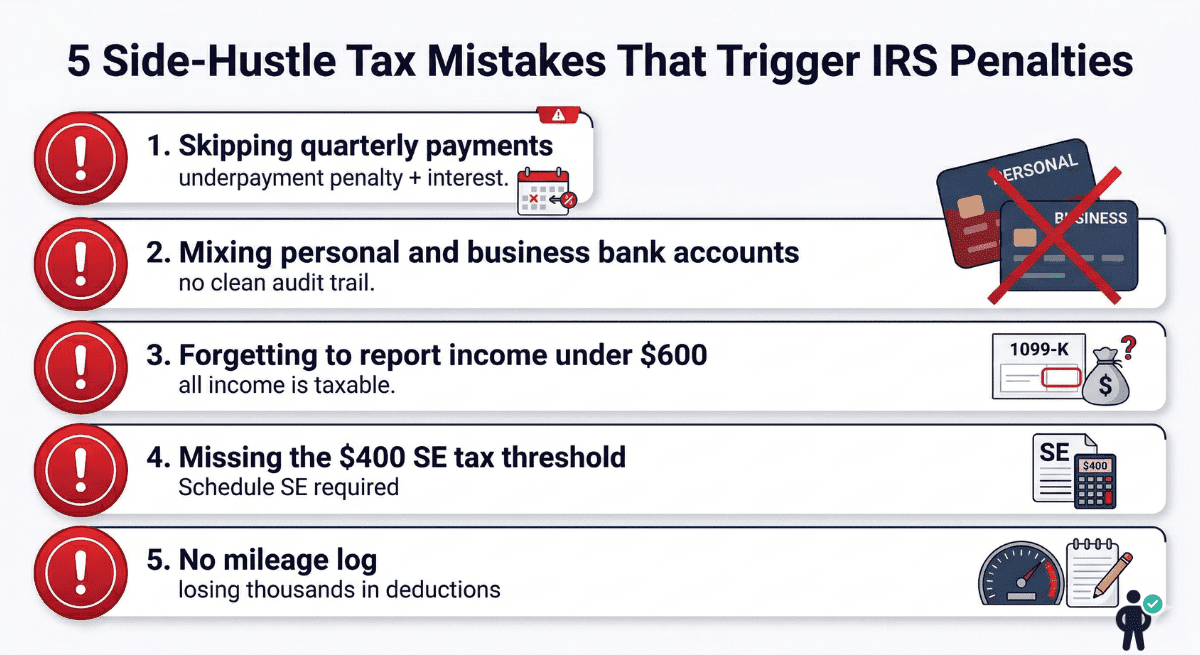
Mistake 1 — Not making quarterly estimated payments. This is the most expensive mistake a side-hustler can make. The IRS underpayment penalty is calculated daily and compounds over the year. A side-hustler with $30,000 in net income who skips all quarterly payments can expect to pay several hundred dollars in penalty interest on top of their tax bill — in addition to potential penalties.
Mistake 2 — Mixing personal and business bank accounts. Using your personal checking account for business income and expenses creates an audit nightmare. It makes it nearly impossible to produce clean financial records, and it signals disorganization to the IRS. Open a dedicated business checking account — many banks offer free business checking for sole proprietors.
Mistake 3 — Only reporting 1099 income. Clients are not required to send a 1099-NEC if they pay you less than $600 — but you are still required to report the income. Side-hustlers who rely on 1099s to determine what to report are systematically underreporting taxable income.
Mistake 4 — Ignoring the $400 SE tax threshold. Many first-time filers believe the standard deduction ($14,600 for single filers in 2025) protects all their income from taxation. It does not protect from self-employment tax. SE tax applies on net earnings above just $400 — even if your total income is well below the standard deduction level.
Mistake 5 — Reconstructing a mileage log at tax time. The IRS requires a contemporaneous mileage log — meaning recorded at the time of travel. Reconstructed logs are a known audit trigger and frequently disallowed. Use a mileage tracking app from the first day you start driving for business.
Side-Hustle Types Tax Comparison Table
| Side Hustle Type | Key Deductions | Primary Form | Sales Tax? | Complexity |
|---|---|---|---|---|
| Rideshare (Uber/Lyft) | Mileage, phone, car expenses | Schedule C + 1099-K | No | Medium |
| Freelance (design/writing) | Home office, software, internet | Schedule C + 1099-NEC | Usually no | Medium |
| E-commerce (Etsy/eBay) | COGS, shipping, platform fees | Schedule C + 1099-K | Yes (platform collects) | High |
| Content creation (YouTube) | Equipment, home office, software | Schedule C + 1099-NEC | No | Medium |
| Tutoring / coaching | Materials, platform fees, travel | Schedule C (self-report) | No | Low |
| Food delivery | Mileage, phone, insulated bags | Schedule C + 1099-NEC | No | Low |
Frequently Asked Questions (FAQ)
Q1: Do I pay taxes on side-hustle income under $600?
Yes — absolutely. The $600 threshold only determines whether your client is required to send you a 1099-NEC. It has nothing to do with your own reporting obligation. If your net self-employment income from all sources exceeds $400, you must report it and pay self-employment tax. Income under $600 from any single client is still taxable income and must be reported on Schedule C.
Q2: When are side-hustle quarterly taxes due in 2026?
There are four quarterly payment deadlines in 2026 for income earned during 2025 and early 2026: April 15, 2026 (for Q1 income), June 16, 2026 (Q2), September 15, 2026 (Q3), and January 15, 2027 (Q4). These deadlines apply to your 2026 income year estimated payments. Payments for your 2025 annual tax liability are due in full by April 15, 2026.
Q3: Can I deduct a home office for Uber or rideshare driving?
Yes — but it requires careful documentation. If you use a dedicated space in your home exclusively and regularly for business purposes related to your rideshare activity (for example, trip planning, accounting, customer communication), you may qualify for the home office deduction. The space cannot be your car or a shared family area. The deduction is calculated as the percentage of your home’s square footage used for business times your home expenses (rent, utilities, insurance).
Q4: What is the self-employment tax rate for side hustles?
The self-employment tax rate is 15.3% of your net self-employment earnings — composed of 12.4% for Social Security (on earnings up to $168,600 for 2025) and 2.9% for Medicare (no income limit). On net earnings above $200,000 ($250,000 for married filing jointly), an additional 0.9% Medicare surtax applies. You can deduct 50% of the SE tax paid when calculating your adjusted gross income, which partially offsets the burden.
Q5: Do I need to file Schedule C for $1,000 in Etsy sales?
Yes — if your net profit from Etsy sales exceeds $400. Schedule C is required for any business profit above this threshold. Note that $1,000 in gross sales is not the same as $1,000 in net profit. After deducting the cost of materials, Etsy listing fees, packaging, shipping supplies, and any home studio costs, your net profit may be significantly lower — and possibly below the $400 threshold. Always calculate net profit, not gross revenue, when determining your filing obligation.
📋 Get the Printable Side-Hustle Tax Checklist
One-page PDF summary of all 15 steps, key deadlines, top deductions, and forms list. Enter your email below and we’ll send it instantly — free.
No spam. Just the checklist. Unsubscribe anytime.
Final Action Items: Get Tax-Ready Before April 15
Everything in this guide is only useful if it leads to action. Here are the four most important things to do right now — regardless of where you are in the tax year:
Gather All 1099s by January 31
Contact any client who paid you $600+ and has not yet issued a 1099-NEC. Check your email and mail for 1099-K forms from PayPal, Etsy, and other platforms. Do not wait — payers are legally required to send these by January 31.
Run a Profit and Loss Statement
Total all income from every source. List every deductible expense with receipts attached. Calculate your net profit. This single number drives everything — your SE tax, your income tax, your QBI deduction, and your quarterly payment amounts.
Calculate Your Q1 Estimated Payment
If you have 2026 side-hustle income already, your first quarterly payment for 2026 is due April 15, 2026. Use Form 1040-ES or a tax software calculator to estimate the amount. Pay it at irs.gov/payments. Missing Q1 triggers a penalty even if you pay on time in later quarters.
Open a Dedicated Business Account
If you are still using a personal account for side-hustle income and expenses — open a separate business checking account this week. This single step will save you hours at tax time, make your deductions defensible, and signal professionalism to any IRS reviewer.